



Design Thinking: A Human-Centered Framework
What if your best ideas don’t come from having all the answers—but from asking the right questions?
That’s the essence of the Design Thinking framework, a mindset and process that helps professionals address real problems through empathy, experimentation, and structured creativity.
Unlike traditional problem-solving methods that start with constraints or assumptions, Design Thinking begins with people. It’s about understanding human needs first, then designing solutions that are not just innovative, but meaningful and practical.
The Five Phases of Design Thinking
- Empathize
Begin by deeply understanding the people you’re designing for. This involves active listening, interviews, observation, and immersion in the user’s experience. The goal is not just to collect data—but to feel what they feel. - Define
Synthesize your findings into a clear and concise problem statement. It’s not just “What’s wrong?”—but “What’s worth solving?” This stage frames the challenge from a human perspective. - Ideate
Brainstorm without limits. Encourage a wide range of ideas—from the safe to the wild. The aim isn’t to land the perfect solution immediately but to unlock new perspectives through volume and diversity of thought. - Prototype
Build quick, low-cost versions of your ideas. A prototype is not a final product; it’s a conversation starter, a test object, a way to explore and refine your thinking through feedback and iteration. - Test
Take your prototypes back to the people. Observe, ask questions, and adapt. The solution may change entirely—and that’s a strength of the process, not a flaw.
Why Professionals Choose Design Thinking
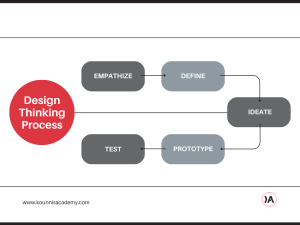
Design Thinking is used by leading global companies, startups, and social innovators because it:
- Encourages cross-functional collaboration
- Reduces risk by validating ideas early
- Builds stronger customer loyalty through empathy
- Accelerates innovation in uncertain or complex environments
Whether you’re rethinking a customer journey, redesigning an internal process, or creating a new product, the Design Thinking framework gives you structure without rigidity—and creativity without chaos.
Turn Problems into Opportunities
At Kounnis Academy, we don’t just teach frameworks—we help you apply them with purpose. Our seminars combine expert guidance with hands-on practice, so you can solve real-world challenges with clarity and confidence.
Explore our upcoming seminars and start turning insights into action.

